Tag Archive for: Laos

Ing Hang Stupa, a religious monument and national heritage site in Savannakhet Province, is undergoing restoration, with the first phase already completed and the second phase about to begin.

The Department of Information, Culture and Tourism of Savannakhet Province is leading the restoration. The team completed the first phase on 16 June, having started on 11. Their survey revealed several cracks and holes in the stupa’s structure.

During this period, repair crews sealed the damaged areas and cleaned off long-accumulated dirt to prevent water seepage during the rainy season.

The second phase will focus on fixing larger cracks.

Restoration teams plan to follow conservation standards by preserving the stupa’s original materials and design. Before moving forward, experts will collect and analyze material samples to guide the next stage of repairs.

Funding for the project comes from the temple’s own budget, public donations, and contributions from the community. The team also plans to add decorative lighting around the temple grounds to enhance its appearance.

To improve the visitor experience, the Provincial Tourism Department has organized dedicated shop spaces and parking areas.

Although a plan for the second phase is already in place, the start and end dates remain uncertain.

The project, which aims to preserve the site’s cultural value and improve tourism infrastructure, will continue in multiple stages.

Dating back to the 16th century and standing about nine meters tall, Ing Hang Stupa remains one of Savannakhet’s most important cultural and spiritual landmarks.

Source: https://laotiantimes.com/2025/06/20/heritage-stupa-in-savannakhet-restoration-enters-second-phase/

That Nang Lao stupa and Thong Na Ngueak were officially recognized as Laos’ local national heritage sites in Savannakhet Province.

On 2 May, Vilabouly District held a cultural ceremony to officially declare the Nang Lao stupa and Thong Na Ngueak (Mermaid Rice Fields) as local-level national heritage sites.

Deputy Governor of Savannakhet Province, Lingthong Saengtavanh, led the ceremony, joined by district chief Valiya Sichanthongthip, local officials, and community members. 

That Nang Lao Lao began the restoration in 2017, which was successfully completed within two years. After being proposed as a National Heritage site two years ago, it has now been officially approved, standing as a renewed symbol of spiritual and cultural significance. 

Over 1,000 performers participated in the celebration, featuring traditional drum processions from Nam Mahi, Keovilai, and Hai villages, as well as cultural dances performed by local students and the Vilabouly District Women’s Union.

That Nang Lao Stupa

This historic stupa, located about 180 kilometers east of Savannakhet’s provincial capital, carries a rich royal history dating back to the early 1800s. 

According to the local legend, during King Anouvong’s reign (1805-1828), Queen Khamphao (his sixth concubine) was sent to govern the area of Mueang Vang-Angkham, now Vilabouly.

When the Queen reached what is now the  Phouthai area, Na Te village, her loyal elephant refused to journey further. 

Taking this as a sign, she established her settlement there. The local people call her “Nang Lao” (Lao Woman) because she was not of Phouthai descent, and after her death, they built this stupa in her honor.

What makes a stupa special is its northern Lan Xang (now Laos) architectural style, similar to the structure in Luang Prabang, the Queen’s birthplace. 

Local traditions continue to honor this legacy. Villagers celebrate an annual festival during the third full moon, commemorating the day of the royal elephant’s death. 

The surrounding landscape also preserves this history, approximately 800 meters from the stupa,  where the royal elephant’s remains were buried.

Thong Na Ngueak or Mermaid Rice Field

Thong Na Ngueak, which would roughly translate to “Mermaid Rice Field,” a 3.66-hectare site within the Sepon Gold and Silver Concession Area, gained archaeological significance in 2019 when experts discovered over 75,000 artifacts estimated to be 2,500 years old. 

These findings portray an important connection between the region’s ancient history and its enduring cultural traditions.

The site’s name comes from local mythology about two serpent-like creatures called “Ngueak” who settled along the Xe Bang Hieng River and the Sekok River after being banished from the Kading River, Bolikhamxai province. 

These creatures terrorized nearby villages by demanding annual sacrifices of young virgins, creating such fear that many villagers abandoned their homes.

The situation reached a breaking point when the daughter of a powerful Bru tribal (indigenous ethnic group in Laos, Vietnam, and Thailand) chieftain became a victim. The chieftain enlisted a man named Taluek Nuek to hunt down the “evil” creatures. 

After a seven-day search that left holes across what is now called Na Mor, they captured the ngueak pair. 

When the female ngueak was killed, her blood stained the mountain red, giving it the name Phu Pha Dang, or “Stain Mountain.” The male, though badly wounded, escaped.

The official recognition of the That Nang Lao​ Stupa and Thong Na Ngueak as local national heritage sites is a significant step in preserving Savannakhet’s cultural and historical legacy.

Source: https://laotiantimes.com/2025/05/09/savannakhets-that-nang-lao-stupa-recognized-as-local-level-national-heritage/

Laos has been included in a list of the world’s fastest-growing tourism destinations with one of the highest increases in visitor numbers year-on-year.

According to statistics compiled by the United Nations World Tourism Organization (UNWTO), international tourist arrivals grew by 4 percent in 2019.

Not surprisingly, France and Spain topped the list of the most popular countries internationally, but the UNWTO reports the Middle East (+8 percent) was the fastest-growing region for tourism, with Asia and the Pacific following close behind, up by 5 percent.

The Americas saw the least growth in tourism, down 2 percent, with the US down 1.3 percent.

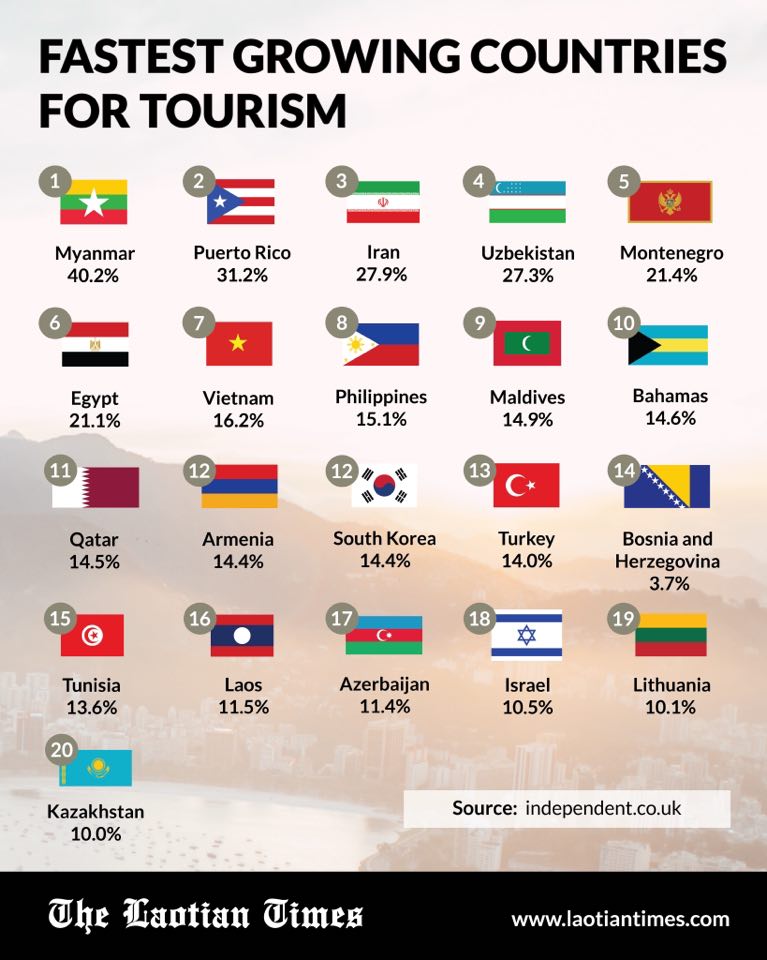
According to Britain’s Independent online news website, the top twenty fastest growing tourist destinations in the world are:

Laos one of World's Fastest Growing Tourism Destinations
Laos is one of World’s Fastest Growing Tourism Destinations

Myanmar topped the list of fastest-growing tourism destinations, while Vietnam took 7th place and the Philipines 8th position.

Laos has taken 16th place in the list of top twenty fastest-growing tourism destinations in the world.

In 2020, the Lao government expects to attract around 4.7 million international visitors and raise more than USD 900 million in revenue.

More than 756,900 Chinese visitors came to Laos in 2019, an increase of about 26 percent over the same period in 2018, with the Vist Laos-China Year being hailed as a success by authorities.

Vientiane Times reported that the department of Tourism Marketing under the Ministry of Information, Culture, and Tourism, is working on a campaign to encourage Lao people to travel within the country, as part of the national socio-economic development plan for 2020.

Source: https://laotiantimes.com/2020/02/07/laos-in-top-20-fastest-growing-tourism-destinations/

Laos has taken third place in the Wanderlust Reader Travel Awards 2020 by British travel magazine Wanderlust that covers adventure, cultural and special interest travel.
Each year in October and November the magazine asks its readers to rate their travels of the past year. The awards reach an audience of around half a million responsive and curious travelers and have been established for over 15 years, according to the magazine.

Laos scored 96.25 percent of satisfaction rates, winning the bronze medal in the awards.

“Lovely Laos rounds out the top three. Probably because it sums up laid-back South-East Asia just right,” the magazine said.

“Laos is smiley, scenic, good value and offers delicious cuisine, with a pleasing amount of characterful hotels and modern comforts. Not so much that it’s lost its charm and soul, though. Long may that last.”

Wanderlust magazine

Namibia topped the awards with 96.47 percent of satisfaction rates, followed by Peru with 96.33 percent.

Elsewhere in Asia, Japan came 5th with 95.63 percent, Vietnam in 9th with 94.49 percent and India in 10th with 93.33 percent.

In December last year, Laos’s Luang Prabang ranked 11th in a list of top 20 places to travelin 2020, published by Architectural Digest. In the same month, Laos’s Kuang Si Falls in Lung Prabang ranked 26th in the list of 50 most popular destinations for Japanese tourists in 2019 compiled by TripAdvisor Japan, marking the first time for a tourist site in Laos to make the list.

Separately, in October last year, Booking.com Japan named Vientiane as the best city for walking tours in Southeast Asia where tourists could explore the city on foot day and night.

At that time, the website said tourists could walk down streets lined with French colonial-style buildings and visit historic sites and monuments such as Pha That Luang.

Source: The Laotian Times