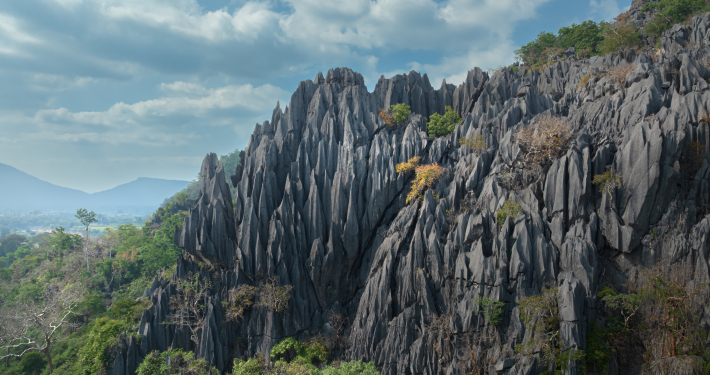
4. Hin Nam No National Park was officially inscribed as Laos’ first Natural World Heritage Site and recognized as the country’s 4th World Heritage Site on July 13, 2025. The official announcement was passed during the 47th session of the World Heritage Committee in Paris, France.
The unique highlights and fascinating details of this World Heritage Site include:
1. Transboundary World Heritage Site
Hin Nam No was inscribed jointly as an extension of the adjacent Phong Nha-Ke Bang National Park in Vietnam, making it the first transboundary natural World Heritage Site in the Mekong region. Combining both sides creates one of the world’s largest contiguous limestone karst protected areas, with the Lao side alone covering approximately 94,121 hectares.
2. Location and Meaning of the Name
-
Location: Situated in Boualapha District, Khammouane Province, in central Laos, bordering Vietnam.
-
Meaning: The name “Hin Nam No” translates to “Spiky Rock Shoots” or “Spiky Stone Buds,” perfectly describing the sharp, jagged limestone peaks resembling bamboo shoots that define the landscape.
3. Geological and Cave Highlights
-
Karst Landscape: Formed over hundreds of millions of years, the area features towering limestone cliffs (some exceeding 300 meters), hidden valleys, and numerous sinkholes. More than 170 caves have been discovered and documented here.
-
Xe Bang Fai Cave (Tham Khoun Xe): The crowning jewel of the park, this is one of the largest underground river caves in the world. It features a 7-kilometer navigable underground river passage with massive caverns reaching up to 120 meters in height and 200 meters in width, filled with breathtaking stalactites and stalagmites.
4. Rich Biodiversity
Hin Nam No is an exceptionally biodiverse area and serves as a vital refuge for globally rare and endangered wildlife:
-
Mammals and Primates: It is a key habitat for the strikingly beautiful Red-shanked Douc Langur, Francois’s Langur (black langur), and the Slow Loris.
-
Lao Rock Rat (Khanyou): A primitive mammal once thought to have gone extinct millions of years ago (a “living fossil”) but discovered alive for the first time in the world in this region.
-
Flora and Other Fauna: The ecosystem hosts more than 1,500 plant species, rare birds (such as hornbills), various reptiles, the Giant Huntsman Spider, and unique cave-adapted aquatic species that have lost their eyes due to living in perpetual darkness.
5. Historical and Cultural Values
Beyond its natural wonders, the area is home to ethnic minority groups who maintain traditional livelihoods and forest-linked spiritual beliefs. Historically, during the Indochina War, these rugged karst formations and cave networks served as vital shelters and formed a strategic section of the historic Ho Chi Minh Trail.
🚗 Travel and Tourism
-
Getting There: Visitors typically travel first to Thakhek town (the capital of Khammouane Province) and then take a 3-to-4-hour drive by road to Boualapha District.
-
Activities: Key activities include boating or kayaking through the Xe Bang Fai Cave, trekking and climbing across the karst terrain, and participating in community-based eco-tourism led by local village guides.