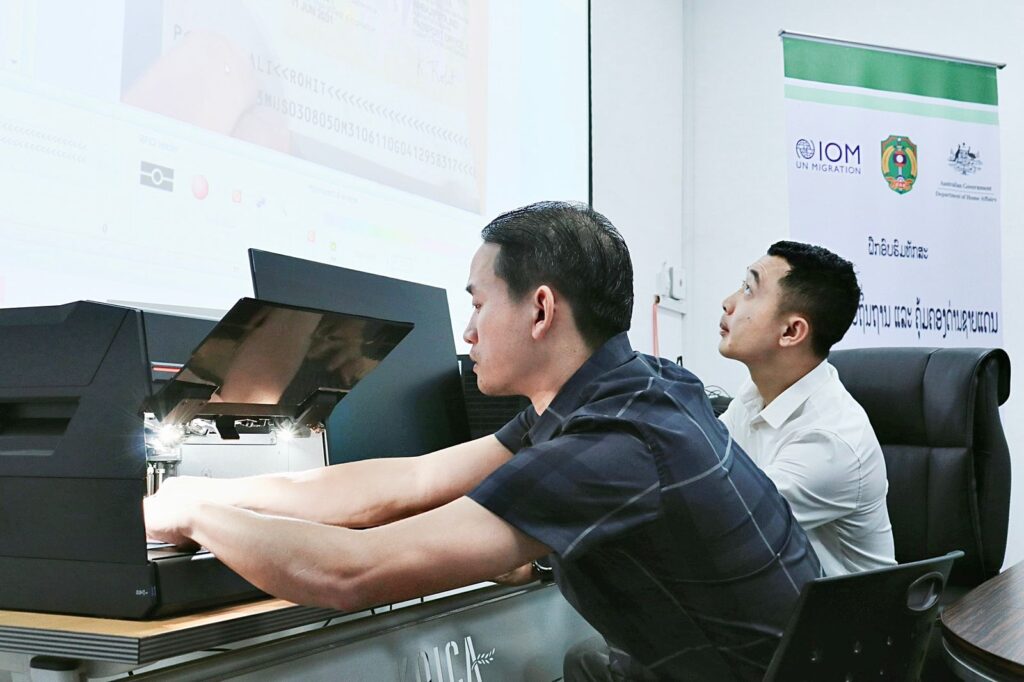
With the Chinese New Year approaching, the Laos-China Railway has rolled out special measures at the Bohan Railway Border, including expanded counter services and a lane for travelers, to manage the surge in passenger flow.

Starting from 13 January, the Bohan Railway Border has expanded its counter services and opened a dedicated lane for “People Returning Home During the Chinese New Year.” This special crossing prioritizes elderly travelers, pregnant women, children, and others needing extra assistance. 

The lane was usually reserved for emergencies and now has been opened for the holiday season to help ease congestion. Additional measures, including “classified crossings” and “peak service windows,” have also been implemented to improve efficiency for all passengers.

In Vientiane, the Chinese New Year celebrations officially began on 15 January with an opening ceremony under the theme “Drinking from the Same River, Living in Harmony as One Family.” The event highlighted the cultural bond between Laos and China, with both the Chinese New Year and the Lao Lam Vong Dance recently recognized as UNESCO World Cultural Heritage.

The following day, the arrival of the D87 train from Kunming to Vientiane marked the start of the Spring Festival cultural event along the China-Laos Railway. 

Passengers experienced live performances by Chinese and Lao artists, turning the train journey into a lively cultural experience including traditional songs, dances, and festive activities, such as the sampling of Pu’er tea and Yunnan coffee.

Source: https://laotiantimes.com/2025/01/18/laos-china-railway-expands-services-for-chinese-new-year-travelers/

Houaphanh Province will officially add Pa Bum sauce and Tai Daeng traditional singing as Cultural Heritage on 30 December, said the provincial governor.

Located in the northern part of Laos, Houaphanh Province shares borders with Vietnam, Xiengkhouang Province, and Luang Prabang to the west. The province is home to a wide variety of ethnic groups, including the Khmu, Hmong, Lao Theung, and Tai Daeng.

In Houaphanh, traditions passed down through generations remain deeply valued by the local communities. Residents actively preserve their cultural heritage as a symbol of identity, highlighting the importance of traditions like Tai Daeng singing and Pa Bum sauce, which truly represent Houaphanh to visiting tourists. 

Pa Bum sauce

Pa Bum Sauce, also known as “Jeo Pa Bum Sam Neua,” is a traditional dish central to daily life in the region. The recipe, passed down through generations, includes fish, chilies, garlic, Sichuan pepper, and a variety of seasonings, all of which are combined and fermented in a jar or wrapped in a wooden stick. 

The sauce is typically enjoyed with sticky rice and boiled vegetables like bamboo shoots, apple gourds, and cabbage, along with other staple Lao dishes.  

Tai Daeng singing

Tai Daeng singing is a unique musical tradition of the Tai Daeng ethnic group, characterized by a harmonious blend of traditional Lao instruments such as the Khaen, flute, and pipe, alongside the human voice. 

The music consists of four distinct types: Khub Oiy, Khub Aun, Khub Soy Vai, and Khub E Dou Num Nae. Each style has its own unique sound and method of performance, contributing to the region’s diverse musical heritage. 

Tai Daeng singing is typically performed during important ceremonies, prayers, and traditional celebrations, such as weddings.

In a similar move to preserve cultural heritage, Houaphanh Province previously recognized the tradition of Khub Sam Neua and the knowledge of silk fabric weaving as local cultural heritage in a ceremony held on 23 November 2022. 

Source: https://laotiantimes.com/2024/12/27/houaphanh-to-officially-recognize-tai-daeng-singing-pa-bum-sauce-as-cultural-heritage/

Starting January 2025, airlines are set to increase flights to Houaphanh province to accommodate the growing number of tourists.

On 26 December, Malaythong Bounyaxay, Head of the Houaphanh Provincial Information, Culture, and Tourism Department reported that the tourism atmosphere in Houaphan Province is “very busy”

“The accommodation facilities in the province are full almost every day,” said Malaythong, adding that the flights from Vientiane to Houaphanh province are currently full.

 “Therefore, there will be more flights from to Houaphanh province provided by Lao Airlines, Lao Skyway, and Lanexang Airways to accommodate and satisfy the increasing number of tourists next year.”

Although confirming the increase in flights, the provincial tourism official noted that the exact start date for operations has not yet been finalized.

According to the report provided by Malaythong, the province welcomed a total 53,232 travelers including 16,881 international travelers and 36,351 domestic visitors from January to December, building on significant growth from the previous year over 10 percent, and gained income over LAK 58 billion (USD 2.6 million). 

Vietnamese tourists topped the list of visitors, largely due to Vietnam sharing a border with Houaphanh province. China and Japan followed in the rankings. Officials anticipate even greater numbers as the peak tourist season extends into the coming year.

Houaphanh’s top travel destination is nestled in Viengxay district, celebrated for its Cherry Blossoms (Sakura). Designated as Houaphanh’s provincial flower in December 2022. Earlier, the province hosted its annual Sakura Festival between 22 to 24 December.

Source: https://laotiantimes.com/2024/12/26/houaphanh-province-to-expand-flight-services-amid-tourism-boom-in-2025/

Khammouane Province unveiled its newest eco-tourism destination, Tat Sieng Lue Waterfall, on 20 December, offering visitors a mix of natural beauty and outdoor adventure.

The site, located in Napoung village, about 140 kilometers from the provincial capital, Tat Sieng Lue provides a peaceful retreat for nature enthusiasts and thrill-seekers alike.

The area is being developed by Saiphuluang Group, a local company with a 40-year concession, investing over USD 12 million.

Visitors can already enjoy campsites, ethnic homestays, restaurants, scenic photography spots, trekking bridges, flower gardens, and waterfall views, all supported by modern facilities.

Khammouane Province is home to 199 tourist sites, including 140 nature-based attractions, 30 cultural landmarks, and 29 historical sites.

Among its highlights are the limestone caves such as Tham Nang Aen, Tha Falang, and the famous Konglor Cave.

Source: https://laotiantimes.com/2024/12/26/tat-sieng-lue-waterfall-opens-as-khammouanes-new-eco-tourism-site/

In response to the rising adoption of EVs, LOCA, an electric vehicle (EV) infrastructure in Laos, has set up 40 fast-charging stations across Laos in 2024, focusing on major cities and key routes to boost EV growth and promote sustainability.

The company’s fast-charging stations deliver power at 120-240 kW, allowing EVs to fully charge in just 20-30 minutes. Through the LOCA EV app, users can locate and navigate to charging stations nationwide, view real-time usage status, and ensure worry-free travel from Laos’ northernmost to southernmost points.

LOCA’s expansion has been bolstered by support from the Asian Development Bank (ADB) Frontier Fund and the United States Agency for International Development (USAID). These collaborations have provided substantial financial and technical assistance to advance clean energy projects in Laos. 

The ADB’s investment aims to drive innovation and technological solutions to tackle climate change while encouraging inclusive economic growth. At the same time, USAID’s support has improved clean energy access, cut consumer costs, created jobs, and reduced carbon emissions.

The Growing EV Market in Laos

Demand for EVs in Laos has surged unprecedentedly. 2,101 EVs were imported in 2023, accounting for 25.1 percent of all new vehicle registrations. In the data year to date as of October 2024, the total imported electric cars surged to  4,437, highlighting a consumer shift towards EVs driven by cost efficiency and environmental concerns.

Building on its 2024 success, LOCA aims to expand its fast-charging network to 100 stations by 2026. This growth is designed to accommodate the rapidly increasing number of EV users and promote widespread adoption of electric vehicles across Laos.

Source: https://laotiantimes.com/2024/12/26/loca-sparks-ev-revolution-in-laos-with-40-fast-charging-stations/

On 23 December, the Mekong River Commission (MRC) celebrated the opening of its Education and Visitor Center and the launch of the One Mekong app at its headquarters in Vientiane, Laos. The event also marked the 20th anniversary of Laos hosting the MRC.

The new center showcases interactive exhibits, maps, books, and real-time monitoring tools that highlight the Mekong River’s history and its role in regional cooperation. It will host educational programs, conferences, and learning sessions for researchers, students, and the public, aiming to raise awareness about the river’s importance and the MRC’s work.

A key feature of the center is the Situation Room, which provides real-time river monitoring and forecasting. It connects with the MRC’s Regional Flood and Drought Management Center in Phnom Penh and supports disaster management, climate adaptation, and cross-border collaboration.

The One Mekong app was also launched, giving the public access to real-time data and forecasts about the river.

“Laos is proud to host the MRC Secretariat and this vital hub,” said Prime Minister Sonexay Siphandone. He expressed gratitude to development partners, including Japan, Morocco, and the United States, for supporting the project.

Anoulak Kittikhoun, CEO of the MRC Secretariat, described the center as a bridge between knowledge and action, showcasing the power of science, data, and community engagement. “May this world-class center inspire collective action for the Mekong’s future,” he said.

Source: https://laotiantimes.com/2024/12/25/mekong-river-commission-launches-education-hub-one-mekong-app-in-vientiane/

Traveling between Laos and China is now easier with a QR payment system that enables tourists to make cashless transactions. Chinese visitors can already use QR codes, with plans for Laotian travelers to follow.

On 19 December, the Lao National Payment Network Company Limited (LAPNet) and China’s UnionPay International (UPI) signed an agreement in Shanghai to introduce a QR code-based system connecting the two countries’ payment networks.

The initiative allows payments between LAPNet and UPI members via the UnionPay mobile app, which supports over 160 e-wallets in 37 countries.

Under the system, UnionPay users can pay at merchants linked to eight LAPNet member banks, including Banque Pour Le Commerce Exterieur Lao Public (BCEL), Joint Development Bank (JDB), and Agricultural Promotion Bank (APB).

The first phase, China Scan Laos, is now active, allowing Chinese tourists to use the system in Laos. The second phase, Laos Scan China, will soon let Lao travelers enjoy the same convenience in China, though the exact start date is yet to be announced.

China is now the fourth country to launch a cross-border payment system with Laos, following similar initiatives with VietnamThailand, and Cambodia.

Source: https://laotiantimes.com/2024/12/25/laos-china-launch-qr-payment-system-for-cashless-tourism/

Vientiane Capital’s economy grew by 5.85 percent, surpassing the National Assembly’s initial target of 0.30 percent, according to the city Mayor Atsaphangthong Siphandone. 

Atsaphangthong reported on 16 December that this robust growth was the result of strong performance across agriculture, industry, services, and investments. Key contributors to the economic surge included an 8.5 percent increase in industrial factories and handicraft units, highlighting the city’s thriving industrial and artisanal sectors.

The industrial sector emerged as a major driver of growth, with a total production value of LAK 10 trillion (USD 457.5 million). Handicraft production alone contributed LAK 134 billion (USD 7.02 million), highlighting its significant role in the manufacturing landscape.

Meanwhile, the service sector increased by 3.95 percent, fueled by targeted campaigns to boost tourism and international events such as the Visit Laos Year initiative and the ASEAN Summits. These efforts attracted over 1.53 million tourists to Vientiane.

The agriculture sector also demonstrated resilience with a 4.3 percent growth rate, according to the mayor. Authorities focused on enhancing food security, ensuring a sufficient rice supply averaging 258 kilograms per person annually, and producing a surplus of 7,500 tonnes of goods. Per capita vegetable production reached 101 kilograms, while meat production averaged 70.28 kilograms.

Overall, Vientiane’s total investments across various sectors also reached LAK 31 trillion (USD 1.62 billion), exceeding the National Assembly’s target by 53.84 percent. 

Atsaphanthong further noted that both domestic and foreign private investments played a pivotal role, with contributions totaling LAK 30.22 trillion (USD 1.38 billion), exceeding  the NA’s target by 85.9 percent and achieving 88.31 percent of the annual plan. Additionally, 407 state projects accounted for investments worth LAK 168.61 billion (USD 7.70 million).

Mayor Atsaphangthong highlighted these achievements as evidence of Vientiane’s consistent economic development. With continued focus on key sectors and strategic planning, the city is well-positioned to sustain its growth trajectory in the coming years.

Source: https://laotiantimes.com/2024/12/20/vientiane-economy-hits-5-85-percent-growth-beating-expectations/

On 2 to 5 December, the Young Southeast Asian Leaders Initiative (YSEALI) Summit 2024 brought together 100 young leaders from across ASEAN and Timor-Leste in the World Heritage Site of Luang Prabang, under the theme “Connecting the Creative Economy.” 

The event, supported by the US Department of State, the US Embassy in Vientiane, and YSEALI, was implemented by STELLA and Quack, two youth empowerment groups in Laos.

One of the key highlights of the Summit was the opportunity for participants to engage in masterclasses on cutting-edge topics such as “Creative Economy and Strengths of ASEAN’s Creative Industries.”

But what exactly is the creative economy, and why is it important for the ASEAN region, especially for Laos?

For Phetmany Viyadeth, the Founder of UTD Education Centre in Laos, the creative economy holds immense potential for the country.

“I’ve met so many talented and kind individuals from various creative careers who share a creative mindset, and we share a common interest in supporting our community. I’ve learned that collaboration and shared ideas are key to driving change, especially in the creative economy,” she said.

From the perspective of Keopanya Sengsoulivong, Manager of Pakse Youth Power, the creative economy can transform the lives of young people, especially artists. 

“Back in my hometown of Pakse, we’re working on a collaboration to create more opportunities for the local community. For me, the creative economy is about increasing the value of creative work, especially since many artists, like painters, often struggle financially. Through our ‘Young Talents’ project, we aim to help these young, talented individuals. Creativity not only empowers youth, but it also helps them earn a living,” Sengsoulivong said.

“With my background in education, I see creativity as a tool for developing programs where young people can teach their skills to others and make a living from it. I’m excited about the future of the creative economy, particularly with young leaders stepping up.”

While Laos is leveraging its rich cultural heritage to develop its creative economy, other ASEAN countries such as Thailand, Singapore, Vietnam, Cambodia, and the Philippines are also finding unique ways to grow their creative industries and showcase their cultural identities.

In Thailand, Phitchakan Chuangchai, a Lecturer in Management of Cultural Heritage and Creative Industries at Thammasat University, sees ASEAN’s diverse cultural heritage as a valuable asset. 

“The creative industry is actually composed of our culture, our creativity, our skills, all the talents that we have in the ASEAN region, and these things that we can then add value to the economy and also to our culture,” she said. “So, if we understand this, we see the potential that we have in the ASEAN region, that we have all the cultural diversity and also all the gems that we have.”

Singapore’s Ian Chew, Founder and CEO of Greenie Web, shared his perspective on the thriving digital creative economy. 

“In ASEAN, the digital creative economy is already thriving, with young people using the internet in innovative ways to amplify their impact globally,” he said. “I also believe that the creative economy can help amplify the voices of the underprivileged, ensuring that everyone has equal opportunities to live life to the fullest. The intersection of sustainability and the creative economy will be a major trend over the next 10 to 15 years.”

In Vietnam, Nhat (Estella), Project Manager at 4V Vietnam, is using art to promote sustainability. 

“My work at 4V Vietnam involves transforming trash, waste, and fabric scraps into art. Our vision is to engage artists in ecological and sustainable art practices, using their creations to raise awareness about sustainability,” she explained.

For Cambodia’s Thy Lineth, an artist and social media manager, the creative economy is deeply rooted in traditional culture. “In Cambodia, the term ‘creative economy’ may be new, but it has always been a part of our culture, especially in traditional crafts and arts. Recently, there has been a growing focus on creative industries, which is encouraging,” she said.

The Philippines’ Osep Reyes, Founder of Culture Shock, highlighted the importance of promoting cultural heritage through creativity. 

“In ASEAN, we all face similar challenges, so focusing on the creative economy, especially in promoting our own culture, is important today,” he said. “The summit’s site visits, especially to the Traditional Arts and Ethnology Centre and pottery-making demonstrations, deepened my appreciation for Lao culture. I believe we can adapt modern tools like AI to help. It’s inspiring to see how young people in the Philippines are using cyberspace to reconnect with our roots.”

By empowering young leaders and fostering collaboration, the creative economy is pushing for new opportunities for growth and positive change across the region. 

As digital innovation accelerates and traditional arts gain global recognition, creativity is becoming a drive for sustainability and social impact.

Source: https://laotiantimes.com/2024/12/19/creative-economy-revolution-how-aseans-youth-are-leading-the-charge/

On 12 December, Seno Grilled Chicken was officially recognized by Savannakhet authorities, becoming a new symbol of the central Lao province.

It all started in the early 1990s at a bus stop in Outhoomphone district, where Sing Souliyed and his family set up a small grill to sell their marinated, smoky grilled chicken to weary travelers. Little did they know, their venture would ignite a culinary legacy. 

What started as a simple venture, with just a few skewers sizzling over charcoal, gradually grew into a local sensation, attracting customers from across the district and beyond.

By the early 2000s, around 20 shops had joined the trade, and by 2015, that number had more than doubled. Seno Grilled Chicken had become a must-try dish, with its rich, smoky flavor capturing the hearts of all who tasted it.

In 2017, the Pingkaiseno Association, recognizing the product’s growing reputation and rising customer expectations, set out to secure official recognition for the dish. Their efforts paid off when Seno Grilled Chicken was granted the national ODOP trademark, an endorsement of its quality, hygiene, and market standards.

Keodavan Manivong, owner and operator of Pingkaiseno Shop in Vientiane Capital who is a member of the Seno Grilled Chicken Association, shared her thoughts on the recognition and its impact on local businesses.

“Our shop has been open for around 8 years. We use 100 percent fresh hens from Seno. These chickens are naturally raised by villagers, which give them a unique taste. Grilled chicken is the star of our menu,” she said.

“Joining the Seno Grilled Chicken Association has helped us promote our shop. This recognition also offers an opportunity for local parents to build careers and support each other in improving their businesses.”

The certificate was presented at a formal ceremony held at the district’s Association Club. Speaking at the event, Ratsami Souliyo, President of Pingkaiseno Association, highlighted the product’s growth over the decades. What began as a family operation expanded into a community effort, with more families joining the trade.

Ratsami emphasized that the ODOP certification not only boosts customer confidence but also motivates vendors to uphold consistent quality and hygiene practices. 

Today, the association boasts 52 member shops, each selling at least 20 grilled chickens daily, with total sales reaching between 1,200 and 1,500 chickens per day.

With official recognition, Seno Grilled Chicken has cemented its status as a symbol of community pride and tradition in Savannakhet, bringing people together one skewer at a time.

Source: https://laotiantimes.com/2024/12/19/seno-grilled-chicken-earns-official-recognition-as-savannakhets-new-symbol/