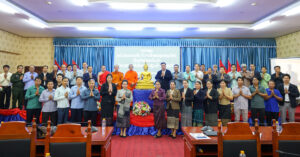
The Ministry of Planning and Investment, in partnership with Bokeo provincial officials, convened on 28 November to discuss plans for the construction of the Suvannakhomkham Buddha statue, which will become Laos’ largest seated Buddha statue.
The meeting provided an overview of the project, which is set to be constructed on Kiu Lom Mountain in the Golden Triangle Special Economic Zone, Ton Pheung District. Standing at 88 meters tall and spanning 45 meters wide, the statue will be crafted from a special metal to replicate the original Buddha statue in Donthat village, reflecting traditional Lane Xang art and the historical identity of Suvanna Khom Kham.
Designed in line with ancient Lao Buddhist art, the statue will feature key elements like the face, ears, and Sangha robes, emphasizing the unique characteristics of traditional Lao Buddha statues. It is envisioned to symbolize prosperity and spiritual protection for the local community while promoting cultural and religious activities.
The project also aims to preserve Lao art and traditions, showcase the skills of Lao artisans, and attract both domestic and international visitors.
https://www.tourismlaos.org/wp-content/uploads/2025/01/BUDDHA-1.jpg6271200Sylivanla Vongphachanhhttps://www.tourismlaos.org/wp-content/uploads/2025/05/Lao-Simply-Beautiful-.webpSylivanla Vongphachanh2025-01-09 16:28:212025-01-09 16:28:26Bokeo to Build Laos’ Largest Seated Buddha Statue
Today, 9 December, marks the 29th anniversary of Luang Prabang’s designation as a UNESCO World Heritage Site. Officially recognized on the same day in 1995, the city has become a symbol of cultural and architectural preservation in Laos.
Founded around 1,200 years ago as Muang Sua, the city took the name of Xieng Thong before becoming Luang Prabang. In 1353, it was declared the capital of the Lane Xang Kingdom, now Laos, becoming a key political and religious center in Southeast Asia.
Although Laos’ capital moved to Vientiane in 1560, Luang Prabang remained the royal capital until 1975, which is reflected in its grand temples, monasteries, and the Royal Palace, now the National Museum.
Before its UNESCO designation, Luang Prabang was a small town, relying on traditional crafts like lacquering and silversmithing, often supported by the royal family.
However, concerns about urban development threatening its historical buildings led to efforts to protect its cultural heritage. Important landmarks, like ancient temples and the Phra Bang Buddha statue, contributed to the city’s spiritual and architectural importance, earning it recognition as a site of global value.
After becoming a World Heritage Site in 1995, the city saw a rise in tourism, turning Luang Prabang into a busy destination for international visitors. Modern infrastructure, such as hotels, restaurants, and the Laos-China Railway, helped develop the city. However, this rapid growth also created challenges in preserving its unique character.
To address these challenges, the Lao government has introduced Heritage Impact Assessments (HIA) to measure how new projects might affect the city’s heritage. A dedicated Heritage Department ensures that the town’s architectural integrity is maintained, while local heritage committees involve the community in preservation efforts. These initiatives aim to balance modernization with conservation, preserving Luang Prabang’s historical charm.
Luang Prabang’s importance goes beyond its buildings. As a regional hub for Theravada Buddhism, the city is home to many temples and monasteries that remain central to the spiritual life of the region. The name “Luang Prabang” comes from the Phra Bang statue, a symbol of protection and guidance for the Lao people.
Over the past 29 years, Luang Prabang has transformed from a quiet cultural gem into a global heritage destination. As the city celebrates this milestone, it continues to inspire efforts to protect the past while embracing the future.
https://www.tourismlaos.org/wp-content/uploads/2024/12/Luang-Prabang-Celebrates-29-Years-as-UNESCO-World-Heritage-Site.jpg6271200Sylivanla Vongphachanhhttps://www.tourismlaos.org/wp-content/uploads/2025/05/Lao-Simply-Beautiful-.webpSylivanla Vongphachanh2024-12-30 09:59:512024-12-10 10:02:36Luang Prabang Celebrates 29 Years as UNESCO World Heritage Site
On 3 December, the Laos-China Railway celebrated its third anniversary.
Since its launch in 2021, the railway has transported 43 Million passengers, including over 740,000 passengers within Laos. It has also moved 4,830 tons of goods.
The Ministry of Information, Culture, and Tourism reported that 85 percent of passengers in Laos traveled between Vientiane Capital and Luang Prabang during this period.
Over the three years since its opening, daily passenger numbers have increased significantly from 20,000 to around 100,000. The range of freight transported has also expanded from 10 categories to over 3,000, featuring Lao exports such as BeerLao, durian, cassava flour, mangoes, and other products bound for the Chinese market.
Between 2021 and 2024, the Laos-China Railway has seen significant growth in both sectors.
On the freight side, the railway transported 3.58 million tons of goods in the first eight months of 2024, a 22.8 percent increase compared to the same period in 2023.
Citing statistics from Kunming Customs, the railway’s freight operations have also grown significantly over the past three years.
By 2024, the railway had transported over 10.6 million tons of import and export goods, valued at more than 44 billion yuan (approximately USD 6.05 billion). In comparison, on 17 January 2022, Kunming Customs approved an international freight train carrying 59,500 tons of goods worth 1.068 billion yuan (approximately USD 147 million).
Laos continues to shine on the global tourism stage, earning 219 ASEAN Tourism Standards Awards for its dedication to sustainability and exceptional travel experiences.
On 26 November, Minister of Information, Culture, and Tourism Suansavanh Viyaket announced these achievements, highlighting areas such as green hotels, clean tourism cities, and community-driven tourism.
The prizes include 113 ASEAN Green Hotel Awards, 12 People’s Homestay Awards, 10 Communities’ Participatory Tourism Awards, Seven Clean Tourism City Awards, 34 Event Venue Awards, 12 Spa Awards, 22 Public Toilet Awards, and six Sustainable Tourism Awards.
In addition, The country has graded 151 accommodation facilities, including five-star hotels and local guesthouses, while over 1,300 businesses have been certified under the LaoSafe hygiene and safety program.
Adding to its accolades, Lonely Planet recently ranked Laos 4th among its Top 30 Places to Visit, spotlighting its natural beauty, rich culture, and eco-friendly tourism efforts.
Silk weaving in Laos has been a cherished tradition for generations. In rural areas, girls often begin learning the craft before the age of ten, guided by their mothers and grandmothers.
They weave traditional patterns onto garments like the Sinh and other traditional clothing, as well as everyday apparel.
The hand-woven patterns vary, with popular designs featuring animals like the elephant and lion, each holding deep spiritual significance.
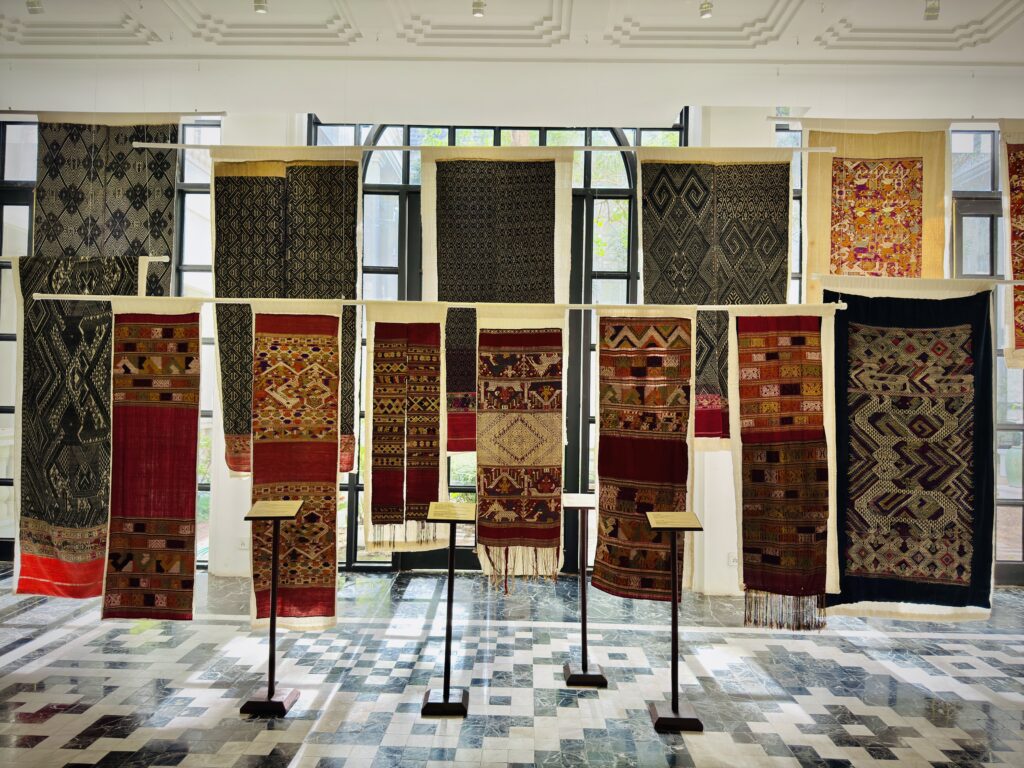
To celebrate this cultural heritage, Vientiane has organized a “Textile Treasures of Laos Exhibition,” which is open from 23 October, 2024, to 28 February, 2025, at the Traditional Laos Silk Residence in Xiengyuen Village, Chanthabouly District.
This symposium aims to highlight Laos’ silk weaving and its cultural importance. It brings together artists, designers, researchers, and textile lovers from all over the world to share knowledge and work together to preserve traditional textile arts. The event will have speakers from different fields, including experts in natural dyes and museum curators.
Head Clothes
This pattern, featuring Naga and bird motifs, is over 100 years old and belongs to the Tai Daeng ethnic group from Houaphanh Province. It was once commonly worn as a headpiece in their daily life. The fabric is handwoven silk, dyed with natural colors, and crafted using both discontinuous and continuous supplementary weft techniques.
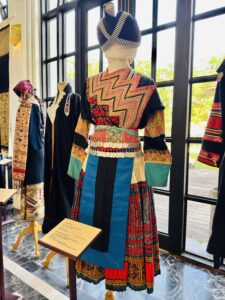
Hmong Traditional Dress
This Hmong Traditional dress from Xaysomboun Province is approximately 90 years old, representative as pleated skirt hemp wax resists applique with natural dye.
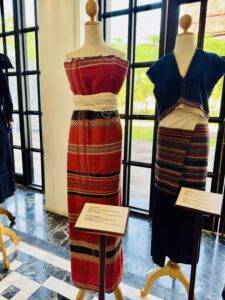
Yaru Traditional Dress
A 60 years old Sinh from the Yaru ethnic group in Champasak Province, showcasing detailed geometric motifs woven with backstrap loom techniques and faced cotton.
The Textile Treasures of Laos Exhibition emphasized Lao tradition through the pattern of traditional clothes, it shows the significance of practices of Lao women that handed from ancestors pass through their family. The exhibition opens daily from 9am – 6pm until 28 February 2025.
https://www.tourismlaos.org/wp-content/uploads/2024/12/IMG_6283.jpg6271200Sylivanla Vongphachanhhttps://www.tourismlaos.org/wp-content/uploads/2025/05/Lao-Simply-Beautiful-.webpSylivanla Vongphachanh2024-12-27 09:52:292024-12-10 09:53:59Textile Treasures of Laos: A Celebration of Culture, Craft
Savannakhet Province has witnessed growth in tourism and economic development in 2024.
Tourist arrivals from January to October reached 683,166, marking a 26 percent increase compared to the same period last year, according to Savannakhet Governor Bounchom Ubonpraseuth, who highlighted that promoting tourism has been a key priority for the province.
Bounchom noted that while efforts in the past year have centered on natural tourism, there is a need to emphasize history, nature, and culture further. This, he explained, involves enhancing infrastructure and facilities, supporting local businesses, and attracting foreign investment.
Key initiatives included developing tourism services and products, organizing traditional festivals, and hosting events such as the Savannakhet Souk San Nen Sa Festival, food and beverage festivals, and bicycle caravans.
The province is also investing in renovating Kaysone Phomvihane City, transforming it into a unique historical tourist destination. By preserving its traditional structures, the area aims to serve as a hub for both domestic and foreign tourists.
Alongside tourism, Bounchom also reported that Savannakhet’s economy has grown by 7.8 percent this year, driven by industry and agriculture. The Savan Seno Special Economic Zone, the Sepon mining industry, and various processing industries have played key roles in boosting production, exports, and employment.
One standout contributor is the Sun Paper industry, which operates a large-scale paper production facility in the province. To meet growing demand, the company is expanding its eucalyptus plantations, requiring hundreds of hectares of land to support its production lines.
With continued investment in infrastructure, traditional festivals, and cross-border initiatives, the province is prone to attract even more visitors and investors in the coming years, Bounchom added.
The ASEAN Youth Organization (AYO) proudly hosted the Opening Ceremony of the 7th ASEAN Youth Conference 2024 on 20th November 2024, the 3 days long affair will be held from November 20–23 in Jakarta, Indonesia. This highly anticipated event gathered 80 youth leaders and changemakers from 14 countries including non-ASEAN countries, reinforcing the critical role of young people in shaping the region’s future. Organized in partnership with the ASEAN Secretariat and AYO Kreasi Internasional, the conference was a resounding success, setting a new benchmark for youth engagement in regional development.
Under the theme, “Investing in YOUth: Enhancing Connectivity and Resilience for Our Shared Culture,” the conference spotlighted youth as key contributors to the ASEAN Vision 2045, the region’s roadmap for progress beyond 2025.
The event underscored the importance of sustainable, inclusive, and resilient growth across ASEAN by providing a platform for youth-driven ideas and collaborative solutions. The Project Directors opened the Opening Ceremony for AYC 2024 – Panda Oundouengphachane and Abhishek Vats, who highlighted the importance of volunteer work and the need for compassion and collaboration to ensure that young people exercise every opportunity to reach out and support their local communities.
Distinguished speakers enriched the discussions, including Bovonethat Douangchak, Permanent Representative of Laos to ASEAN, emphasized youth leadership and regional unity in building resilience.
Moreover, Nur Diyana Badarudin, Counsellor at the Permanent Mission of Malaysia to ASEAN, shared Malaysia’s vision for its ASEAN Chairmanship in 2025, focusing on inclusivity and environmental sustainability while urging youth participation in implementing the ASEAN Youth Work Plan 2021–2025.
The conference will feature panel discussions, interactive workshops, and networking sessions, encouraging vibrant exchanges among delegates. Ensuring the conference generates meaningful outcomes. The program will also involve a site visit to the ASEAN Secretariat where the delegates will present their recommendations.
AYO Chairperson, Sarah Rauzana highlighted the significance of this year’s achievements, including winning the ASEAN Prize and recognition in the Enabler Category by the Arab World Youth Council.
“This milestone year for AYO underscores the power of youth as catalysts for change. Youth-driven policies and initiatives are essential for ASEAN’s long-term success, and AYO remains committed to nurturing the next generation of regional leaders,” she said.
The ASEAN Youth Conference 2024 further cements AYO’s role as a bridge between young changemakers and regional policy-makers. It facilitates capacity building for the young leaders to develop confidence in themselves and tomorrow.
According to the official announcement from the Royal Thai Embassy in Vientiane on 18 November, noted that non-Thai nationals in Laos who intend to travel to Thailand for tourism purposes or work within 60 days must apply for all types of visas only through the e-Visa system and are confirmed to make payments in cash with Thai Baht at the Consular Section of the Royal Thai Embassy, and was set to begin on 1 January 2025.
It will take approximately 10 to 15 working days (if all required documents are completely checked) starting from the date of visa fee payment and the embassy will accept visa applications in the current system (on site document format) up until 20 November.
To prepare for the transition to the e-Visa service, The Embassy will not accept any visa applications from 21 to 31 December.
Lao people visiting Thailand for less than 60 days, can travel normally without applying for an e-Visa.
https://www.tourismlaos.org/wp-content/uploads/2025/05/Lao-Simply-Beautiful-.webp00Sylivanla Vongphachanhhttps://www.tourismlaos.org/wp-content/uploads/2025/05/Lao-Simply-Beautiful-.webpSylivanla Vongphachanh2024-12-24 09:44:322024-12-10 09:46:26Non-Thai Nationals in Laos to Apply for E-Visa Only Starting from January 2025
In Laos’ Bolaven Plateau, Champasack Province, the air is often filled with the scent of freshly roasted coffee beans.
There, each cup of coffee reflects generations of tradition and craftsmanship. Renowned for its high-quality Arabica beans, Lao coffee is earning global recognition for its unique flavor and cultural significance.
The southern Lao province is responsible for over 80 percent of the nation’s coffee output. This high-altitude region, reaching 1,300 meters above sea level, features mineral-rich volcanic soil, cool temperatures, and ample rainfall, ideal conditions for cultivating premium coffee beans.
Farmers in Champasack employ traditional coffee-growing practices, handpicking beans to ensure only the ripest cherries are harvested. Wet processing is widely used in the region, where beans are fermented and sun-dried to enhance their complex flavors and aroma.
Highlighting its global recognition, Laos’ renowned coffee brand, Lao Mountain Coffee, won Continental Awards for Asia at the 2022 World Coffee Challenge in Spain. Competing with the finest coffee varieties worldwide.
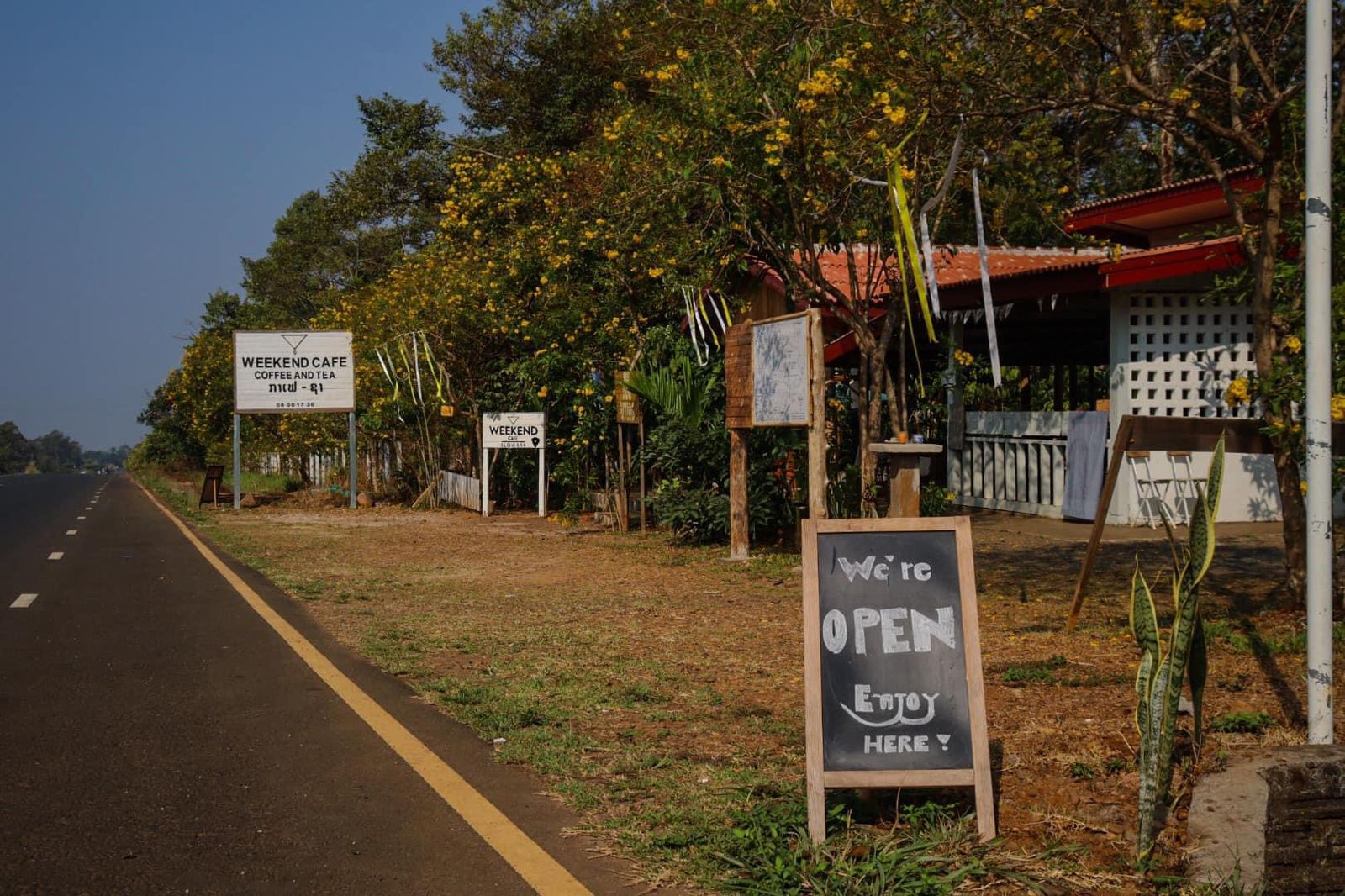
For travelers seeking to experience the essence of Bolaven Plateau coffee, Weekend Café and Camping in Paksong is an ideal first stop, conveniently located near most popular tourist sites in Champasak.
Sokxay ‘Mee’ Yotsopha, 23, owner of Weekend Café and Camping, in Paksong District, Champasack, shared the story behind his coffee shop, which first opened in 2020.
“At first, we didn’t plan to open a coffee shop; it was originally built to sell seasonal fruits,” Sokxay explained. “The name ‘Weekend Café’ was inspired by my university schedule, as I only had free time on Saturdays and Sundays.”
Initially, the café operated only two days a week. By 2023, it expanded to daily operations, with ongoing efforts to improve and develop the business. Growing customer demand led to the hiring of two employees, with plans to add more staff by 2025 to meet the needs of its visitors.
Sokxay’s passion for coffee was shaped by his upbringing on a family coffee farm on the Bolaven Plateau, inspiring the creation of the café.
“Our aim is to create a space for people to exchange ideas about coffee and to make our café a must-visit destination for tourists in Paksong. We’re close to Tad Fane and Tad Yuang waterfalls, making us a perfect stop for travelers.”
The café goes beyond serving coffee, offering green tea, red tea, and other beverages. It also supports the local community by sourcing products from nearby villages and creating seasonal jobs during the harvest, helping to boost the regional economy.
The café primarily uses beans from their own farm but also features varieties from Kenya, Colombia, and Ethiopia. “Our Lao beans are the best sellers and are also distributed to other cafés in the province and other provinces.”
In 2022, Laos exported 20,000 tons of coffee, including 15,000 tons of Robusta and 5,000 tons of Arabica. Despite Robusta’s larger share, Arabica beans have captured international acclaim, spotlighting Laos as a rising star in the coffee world.
The coffee industry sustains approximately 40,000 families across 83,000 hectares, making it Laos’ second-largest export after cassava. Coffee plays a pivotal role in the national economy, supporting smallholder farmers and rural livelihoods.
Laos has recorded over five million tourists this year, exceeding expectations and generating more than USD 1 billion in revenue, Prime Minister Sonexay Siphandone announced on 18 November.
According to the PM, domestic tourist numbers surpassed the target by 27 percent, reflecting the success of the Visit Laos Year 2024 campaign.
Sonexay also credited the surge in tourist arrivals to the Laos-China Railway, which connects key destinations like Vang Vieng, Luang Prabang, and Oudomxay. From adventure activities to UNESCO-listed heritage sites, these provinces offer attractions that have made them top tourist destinations.
To complement these developments, tourism authorities have worked to enhance services at hotels, guesthouses, and restaurants, while adding new facilities at tourist sites.
Looking ahead, the Prime Minister emphasized plans to further promote tourism by targeting specific groups and strengthening collaboration between public and private sectors. Efforts will focus on improving roads, tourist attractions, and facilities, while modernizing tourism management.
Beyond the convenience of the railway, Laos’s distinctive natural and cultural offerings have drawn global attention. For instance, the river trips in Nam Et-Phou Louey National Park have earned widespread acclaim, with Condé Nast Traveler ranking the park among the world’s top 10 best night safaris in February 2023.
Laos’s dedication to sustainable tourism has also garnered international recognition. Luang Prabang, known for its rich cultural heritage, received an award in the 2024 Green Destinations Top 100 Stories for its commitment to responsible tourism and cultural preservation. The award will be formally presented in Chile from 10 to 12 December.
With plans to improve infrastructure and diversify offerings, Laos is set to attract even more visitors in the years ahead.
https://www.tourismlaos.org/wp-content/uploads/2024/12/tv.jpg6271200Sylivanla Vongphachanhhttps://www.tourismlaos.org/wp-content/uploads/2025/05/Lao-Simply-Beautiful-.webpSylivanla Vongphachanh2024-12-22 09:40:182024-12-10 09:42:27Laos Welcomes Over Five Million Tourists in 2024, Generating Over USD 1 Billion